
Tools
Open-source libraries and interactive demos that stand on their own outside the longer case studies on the Projects page.
cogsieve
A Python library that filters polygons by fractional class coverage of categorical rasters, reading windowed pixels directly from remote Cloud-Optimized GeoTIFFs instead of downloading scenes. Three concrete use cases (solar siting, tree equity, wildfire risk) demonstrated on public data.
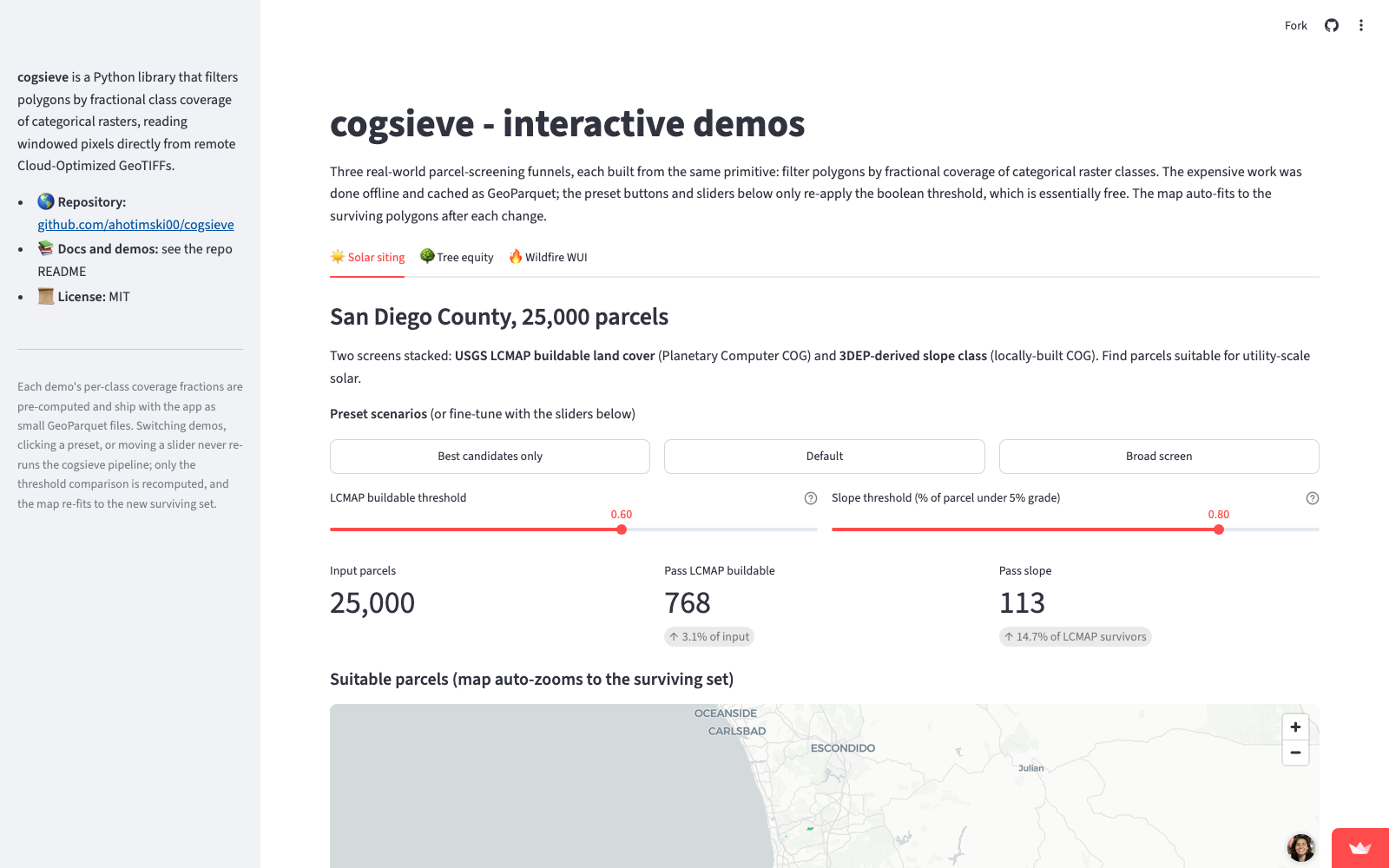
Live demo: cogsieve-vir5swvkd2a5fypnpyqlnn.streamlit.app - three tabs (solar siting, tree equity, wildfire WUI), each with threshold sliders that re-filter cached coverage fractions in milliseconds.
Repository: github.com/ahotimski00/cogsieve
Stack: Python · rasterio · geopandas · exactextract · pystac-client · Planetary Computer · Streamlit · pytest · GitHub Actions
What it does: Given a GeoDataFrame of polygons and a categorical raster (NLCD-style land cover, slope class, burn severity, etc.), compute the exact fractional pixel coverage per class per polygon, then filter polygons by a per-class threshold. Chain multiple screens to build a funnel. One declarative CoverageScreen dataclass carries the configuration for a stage, and the same primitive serves different domain questions just by changing the class codes and thresholds.
Why it is fast: Three design choices stack:
- Exact fractional coverage via
exactextract(C++), instead of the standard rasterize-then-intersect workflow that produces edge artifacts and intermediate vector data. - COG windowed reads over HTTP via rasterio’s
/vsicurl/driver: screens against a 30 GB CONUS LCMAP raster fetch only the tiles intersecting each parcel’s bounding box, no scene download. - Funnel pipeline with content-addressed caching: the second screen only sees parcels that survived the first, and per-stage GeoParquet caches make re-runs essentially free.
A two-screen funnel against 25,000 San Diego County parcels (USGS LCMAP buildable + 3DEP-derived slope) runs end-to-end in 12 seconds. On the same single-screen LCMAP workload, cogsieve completes in 10.7 seconds; rasterstats (the standard pure-Python alternative) takes 320 seconds. cogsieve is 30x faster, measured back-to-back on the same machine against the same Planetary Computer COG.
Three demo domains, all on public data:
- Solar siting (San Diego County): buildable land cover + low slope → 113 utility-scale candidates from 25,000 parcels.
- Tree equity (LA County): low canopy + urban context → 6,213 priority planting block groups from 6,591.
- Wildfire WUI (San Diego County): MTBS burn-severity touch → 45 parcels in the 2007 Witch Fire perimeter.
Approach:
Use exact fractional pixel coverage instead of rasterize-then-intersect. The textbook zonal-stats workflow vectorizes the raster, intersects with input polygons, then sums area per fragment. It introduces edge artifacts at polygon boundaries (a pixel half-inside the polygon either gets counted entirely or discarded) and produces large intermediate vector tables. exactextract computes each pixel’s exact fractional intersection analytically in C++. Cleaner numbers with less code.
Read remote rasters as Cloud-Optimized GeoTIFFs, do not download scenes. The LCMAP and MTBS rasters used here are tens of gigabytes each, CONUS-wide. Naive workflows download the scene, clip locally, then analyze. cogsieve uses GDAL’s /vsicurl/ driver to issue HTTP range requests for only the tiles that intersect each polygon’s bounding box. A state-wide screen pulls tens of megabytes over the wire, not gigabytes.
Treat the screen as a config object, not a function. One frozen CoverageScreen dataclass holds the raster URL, pass classes, track classes, threshold, and an invert flag. The same primitive serves “find parcels with high cropland coverage” (solar) and “find blocks with low canopy coverage” (tree equity) just by changing the class codes and the flag. Made adding the wildfire and tree-equity demos take a few hundred lines each instead of redoing the engine.
Cache aggressively at stage boundaries. The pipeline writes each screen’s per-polygon coverage fractions to a content-addressed GeoParquet keyed by (polygon hash, screen name, classes, threshold). Re-runs with the same inputs replay from cache. The Streamlit demo above demonstrates the payoff: changing thresholds re-uses the cached fractions and only recomputes a boolean, which is why slider moves feel instant.
Engineering bar: typed Python (mypy), ruff-linted, hermetic pytest fixtures (no network in tests), GitHub Actions CI on Python 3.11 and 3.12, MIT-licensed, no proprietary dependencies. The non-obvious choice was making the tests hermetic against a synthetic 4-quadrant raster fixture instead of pulling real data: it means CI runs in under a second and contributors don’t need network access or USDA accounts to verify a change.
parcel-lineage
A Python library that reconciles messy county parcel owner names into their true holdings and tracks ownership change over time. County rolls record the same company under many spellings and bury the controlling entity under tiers of shell LLCs; parcel-lineage cuts through that to answer who actually owns what.
Repository: github.com/ahotimski00/parcel-lineage
Stack: Python · pandas · rapidfuzz · shapely · requests · pytest · typed (mypy) · ruff-linted · MIT
What it does:
- Owner-name reconciliation with no lookup table: normalize (ignoring legal suffixes like LLC and CO) and fuzzy-cluster the spelling variants of a raw roll into one canonical owner, and optionally roll a known corporate family up under one parent via a curated keyword alias.
- Entity resolution against a corporate-family table: roll spelling-clean owners up to their ultimate parent, flagging low-confidence matches for human review.
- Change detection between two time-stamped snapshots: classify each parcel as owner change, boundary change (including partial sell-offs), both, or no change, with an area threshold that filters survey noise.
The ownership pipeline, end to end:
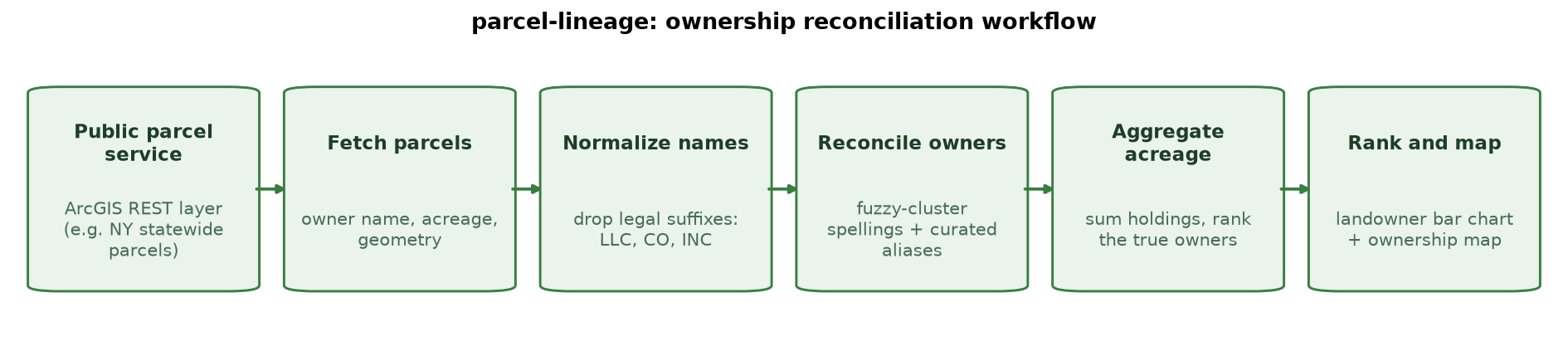
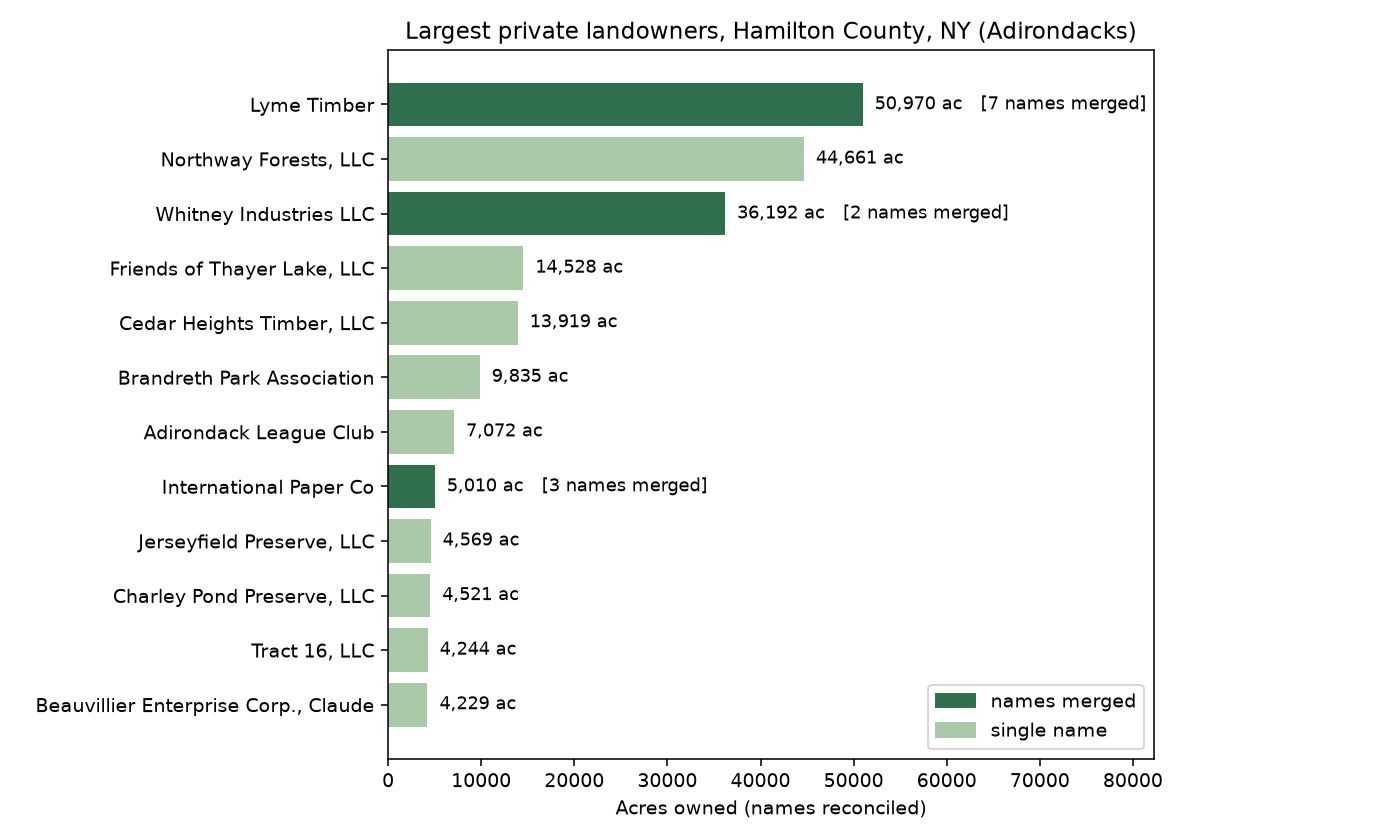
Live on real data: fetch_parcels pulls any public ArcGIS REST parcel layer via a ParcelSource config. Pointed at New York’s statewide service for Hamilton County (Adirondack timberland), the reconciliation collapses 711 raw owner strings to 684, and a curated alias rolls a known timberland family together:
   776,227 ac  State Of New York        [2 names merged]
    50,970 ac  Lyme Timber              [7 names merged]
    44,661 ac  Northway Forests, LLC
    36,192 ac  Whitney Industries LLC   [2 names merged]
The merged-name counts are the point: Lyme Timber is recorded under 7 distinct LLC names (“Lyme Adirondack Timberlands II”, “Lyme / LAT I, LLC”, “Lyme Adk Timberlands II, LLC”, and more), so without reconciliation it looks like several mid-sized owners instead of the single largest private holder in the county.
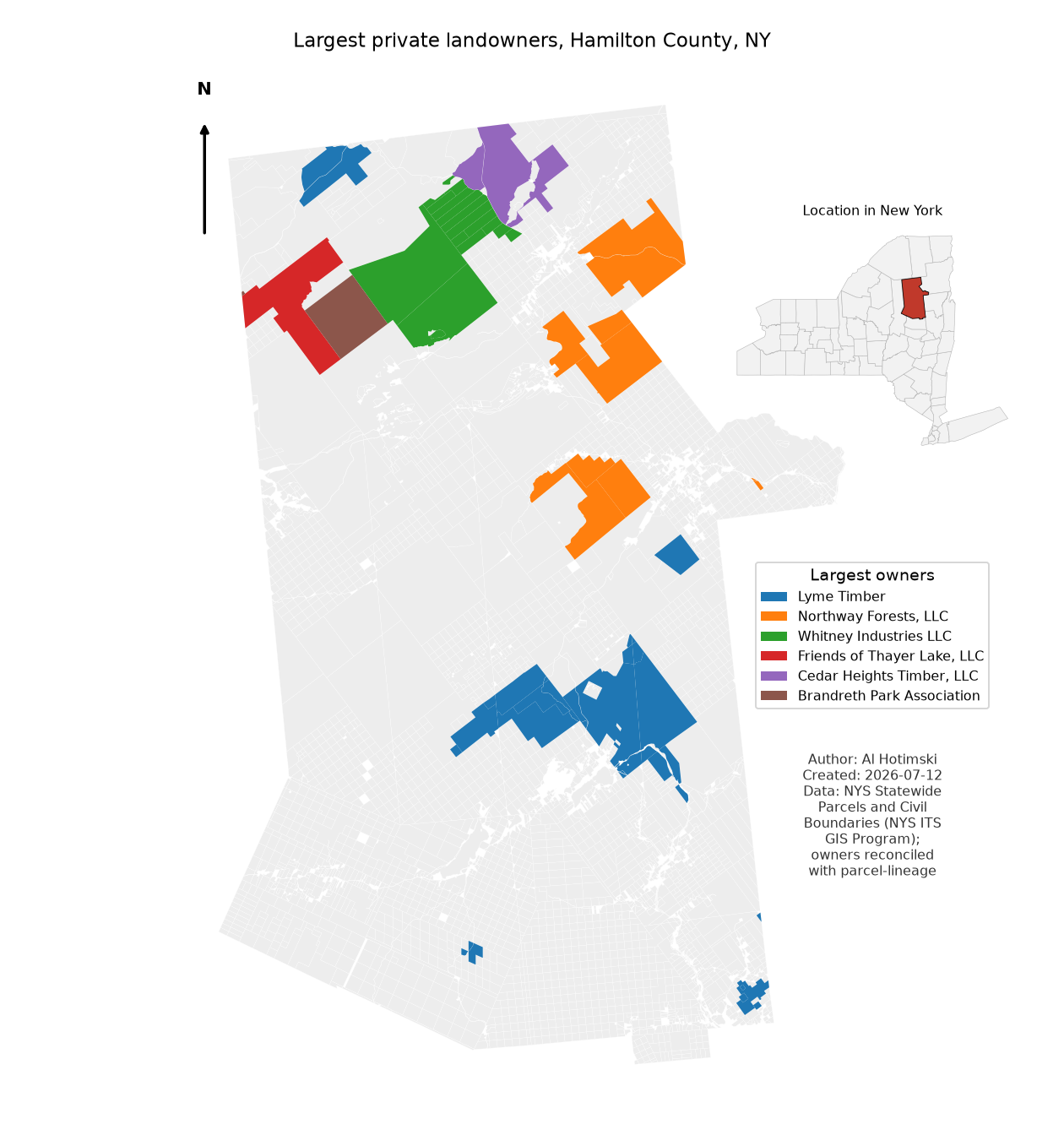
Fetching geometry as well maps where those holdings sit: the six largest private owners’ parcels, colored, across Hamilton County.
Approach:
Reconciliation has two knobs, and both are honest by design. Fuzzy clustering (with legal suffixes ignored) collapses spelling variants of one name; a curated keyword alias rolls distinct names of a known corporate family up to one parent. The alias is a hand-supplied input, not inferred, so it groups the seven Lyme Timber names without fabricating relationships that a shared word alone cannot prove. The fully precise path, a corporate-family table from public filings, plugs into resolve_owners.
County-agnostic loader. ParcelSource names the service URL and the owner, id, and acres fields, so pointing at another county or state is a config change, not code.
Public and verifiable. Built on public data and public code, so it can be read and run end to end. Typed, ruff-linted, hermetic tests (no network in the suite), MIT-licensed.